

Nieuws


0 reacties

263x viewed
In 2026 there will be a lot of changes in terms of laws and subsidies relevant to the energy transition and CO2 emissions of companies. Change Inc. made an overview of nine important changes: from the new Energy Act to the tax addition for electric lease cars.
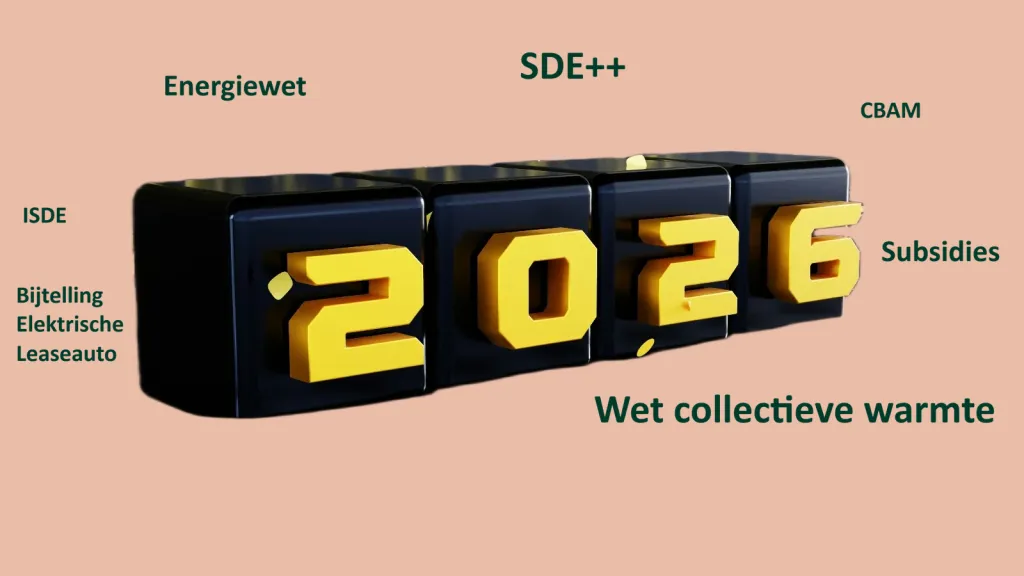
The new year always brings considerable changes in tax and other regulations. In 2026, this is especially true for government laws that affect the energy transition and CO2 emissions of companies. Three major new laws will come into effect on January 1, and in addition there will be a lot of changes in subsidy schemes and tax deductions.
These are the main changes in 2026 in terms of sustainable regulations for companies.
New laws: energy law, heat law and European border tax for CO2
.1. Energy law
The new Energy Law replaces separate laws for electricity and gas, taking into account European directives for the transition to renewable energy. The law will enter into force Jan. 1, 2026.
The new regulations provide better protection for energy consumers, especially households and small businesses. They get more rights in energy contracts, more transparent terms and better protection in billing and supplier failures. All suppliers are required to offer at least one fixed annual contract and licensing requirements are tightened.
To address grid congestion, the law allows for solutions such as demand response, grid congestion management and sharing of grid connections. New data sharing rules make it easier for consumers to access or share their energy data with service providers such as price comparators.
The Energy Act better aligns with the future energy system with more local renewable generation, storage and flexibility. Individuals and companies will have new opportunities to become active in the energy market, for example through energy communities that can sell and supply electricity produced by members. In doing so, the law aims to promote flexible grid use and secure data exchange.
2. Collective Heat Act
Many Dutch buildings and homes still use natural gas for heating and hot water. Collective heat systems offer a sustainable alternative. They allow several homes to be heated simultaneously through one central source, such as industrial residual heat or geothermal energy. For about a third of Dutch buildings, this is the socially cheapest option.
The government aims for 200,000 additional heat connections for existing homes by 2030 and 2.6 million by 2050. Connecting remains voluntary: heat companies must provide clear information about conditions and prices in advance.
The Collective Heat Act replaces the Warmtewet from 2026 and regulates that municipalities determine where collective heat fits best. Heat companies must be more than half publicly owned, allowing municipalities and provinces to retain control over policy.
Pricing for heat is changing fundamentally. Instead of being linked to gas prices, there will be a maximum tariff based on actual construction and maintenance costs. This should ensure fair prices for customers and returns for heat companies.
For the switch, various subsidies are available for residents, building owners, housing corporations and heat companies, including the ISDE scheme for insulation and sustainable heat technologies, SDE++ for large-scale energy projects and the Heat Grid Investment Subsidy (WIS). These can partially recover switching costs.
3. CBAM: European carbon tax for importers
.On January 1, the European Union will permanently introduce a CO2 tax at its external borders. The CBAM mechanism (Carbon Border Adjustment Mechanism) requires importers to pay for the CO2 emissions of certain goods. This prevents "carbon leakage": moving production to countries with less stringent climate regulations. The border tax is intended to create a level playing field for European producers who must pay for their CO2 emissions within the EU.
From 2026, stricter obligations will apply. Importers must then apply for prior authorization as a "CBAM declarant" to import goods. Customs will check this admission when importing goods. The CBAM regulation applies to goods such as cement, iron, steel, aluminum, fertilizer and electricity. Here is the official list of CN codes of products covered by the import duty.
Importers who import more than 50 tons of CBAM goods annually are covered by the scheme and must declare the following year in the CBAM register. After the declaration, sufficient CBAM certificates must be purchased and surrendered. The price per ton of CO2 is the same as in the European Emissions Trading System. If importers or foreign producers have already paid for CO2 emissions, these costs are offset in the declaration.
In the Netherlands, the Netherlands Emissions Authority and the Customs Administration are jointly responsible for implementing the CBAM regulations.
Great subsidy schemes: ISDE, SDE++, DEI+, MOOI, EKOO and HEP
.1. ISDE for entrepreneurs
Business energy users can also apply for the Sustainable Energy Investment Subsidy (ISDE) in 2026. These include SMEs, sole traders, governments, religious institutions, various types of companies, housing associations, associations and vacation home owners. Landlords of rental properties, VvEs, housing associations and housing cooperatives are not eligible.
The subsidy amount is determined by two factors. First, the type of installation. For heat pumps, the type (air-water, ground-water or water-water), energy label (A++ or A+++) and power play a role. For solar water heaters, the effective surface area of the collector and the content of the boiler tank are determining factors. Wind turbines receive a maximum of 140 euros per square meter of rotor area.
In addition to the type of installation, the year of application is also important. Those who apply for a subsidy in 2026 and implement a measure in 2027 will receive a subsidy amount based on the application in 2026.
In certain cases, the grant application is reviewed under state aid rules. For subsidies above €100,000 (for agriculture and fisheries from €10,000) the Rijksdienst voor Ondernemend Nederland registers the application with the European Commission's so-called Transparency Award Module.
2. SDE++ subsidy
The SDE++ subsidy scheme supports companies and non-profit organizations in reducing their CO2 emissions by encouraging them to generate large-scale renewable energy. This is an operating subsidy paid over 12 or 15 years.
There are five main categories: renewable electricity, renewable gas, renewable heat, low-CO2 heat and low-CO2 generation. These can include generating electricity with solar panels, generating heat with electric boilers or CO2 capture systems.
The subsidy covers the "unprofitable top": the difference between the cost price and the market fee. If market prices for green energy are lower than the cost price, the difference is reimbursed. Conversely, the subsidy is zero if market prices are higher than the cost price.
The scheme is open for enrollment for about four weeks each year, usually sometime between June and October. A budget of about €8 billion is expected for 2026.
3. Innovation grants for energy transition
For the coming year the outgoing Schoof cabinet is making a total of 450 million euros in subsidies available through four schemes for innovations that contribute to the energy transition. The schemes will open throughout the year.
The schemes are the MOOI scheme for large partnerships between companies and knowledge institutions that research and develop practical system solutions, the EKOO scheme for smaller research and development projects, the DEI+ scheme for pilot and demonstration projects to reduce or make energy consumption more sustainable, and the HEP scheme for Dutch participants wishing to participate in a European Clean Energy Transition Partnership project.
Fiscal arrangements in 2026
1. Additional tax credit for private use of lease car
Who has a lease car or company car, will have to deal with an addition to taxable income if they drive more than 500 kilometers per year in private with the car.
For 2026, new electric cars are subject to an additional taxable income of 18 percent of the list price on the first 30,000 euros. For the value above that, a rate of 22 percent will apply. This will raise the addition rate over the first 30,000 euros by 1 percentage point compared to 2025.
2. Kilometer charge for trucks
From July 1, 2026, owners of trucks in the Netherlands will face a kilometer charge. This is dependent on a truck's weight and CO2 emissions per kilometer driven. This charge will apply to all domestic and foreign trucks weighing 3,500 kilograms or more.
The truck levy applies to highways, some N roads and municipal roads.
3. Energy investment deduction
Enrepreneurs who want to invest in energy-efficient business assets can take advantage of the energy investment deduction on corporate or income tax. Of the investment costs, 40 percent may be used to reduce taxable profits.
In 2026, however, there will be a aggregation provision that limits the total amount of deductible energy investments to 151 million euros per taxpayer.
Source: Change.Inc