

Nieuws


0 reacties

3x viewed
By our partner LLTB - 22 April 2026
The past year has again provided great insights into ways of growing crops differently in South Limburg. The focus has been on increasing water retention and improving water quality and biodiversity. Wageningen University and Research carried out several trials at the Test Farm Wijnandsrade with the aim of gathering more knowledge on the effects and disseminating this knowledge to farmers in the area. Several field demonstrations have been carried out at farmers in South Limburg, with field meetings also organised.
The trials have yielded several results that are useful for farmers in the considerations of increasing water retention and preventing leaching of valuable fertilisers on agricultural plots. For example, measurements were made on the effect of grain strips in onion cultivation, increasing organic matter on loess soil and comparing various ways of grassland reduction without glyphosate.
Organic matter trial
An investigation was carried out into how adding organic matter (OS) can improve water infiltration in specifically loess soils in southern Limburg and what the effect is on water quantity on the one hand and water quality on the other. This showed that organic matter in particular improves the structure (structure/variation) of the soil, allowing better infiltration and retention of water. It also shows that especially in years with weather extremes, very wet or very dry years, the extra organic matter can also benefit yields. A point of attention is that an excessive supply of organic matter through, for instance, compost can lead to more leaching of nutrients. The measured values remained below the national standard at all properties. It also turned out that to increase the OS content 1% (from roughly 2.5% to 3.5%) in the top layer of 15 cm, a long-term supply of approximately 10 years is necessary. A positive effect of organic matter supply was that soil biology scored a lot higher.
Cereal strips in onion cultivation
Another trial in which measurements were made involved cereal strips in the sowing spurs of onion beds. This measure, which growers from the region themselves suggested, provides additional soil coverage of about 15% whereby, especially at the riskiest time of cultivation, it provides additional coarsening of the plot, reducing the risk of water run-off. The measurements showed that after a heavy (artificial) shower, the vast majority infiltrated and about 30% reduction can be achieved. Last year, however, there was a slight negative effect on yield. This year, the trial will be repeated and also look at how to reduce competition by the grain.
Diminishing grass and green manure
The last trial laid out focused on reducing grassland or grass green manures without using glyphosate comparing various mechanical strategies. Due to the very dry spring, all approaches achieved good results and hardly any grass regrowth was observed. This trial will also be repeated this year.
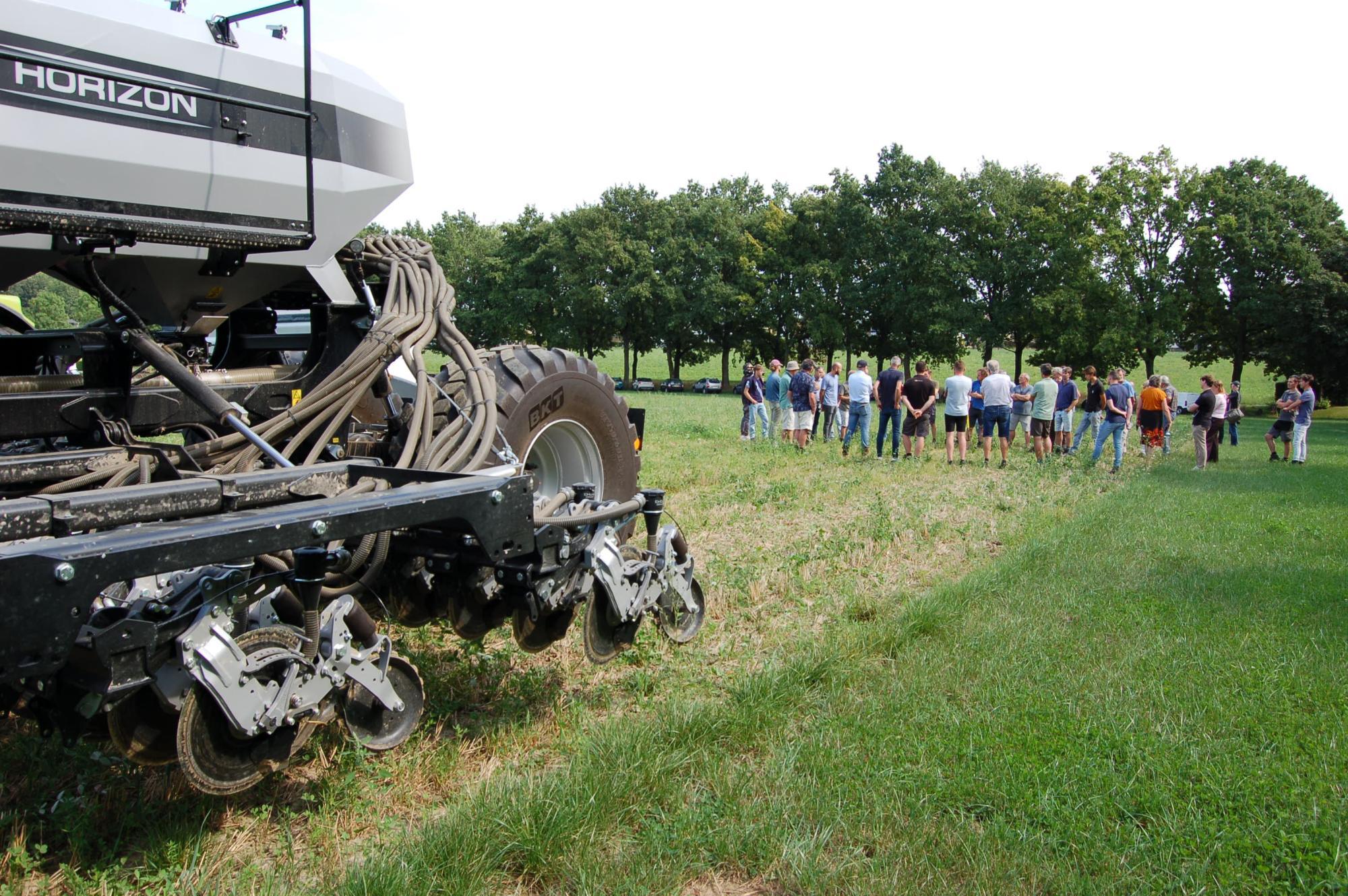
In addition to the substantive results produced by the trials, several meetings were organised where intermediate results were discussed with growers and there was room for discussion and learning experiences from each other. Water runoff and unwanted loss of nutrients to water were central to these.
Valuable
Peter van Dijck, LLTB board member: "For farmers, this is valuable because the trials provide concrete insights for business operations. It is not about theory alone, but about measures that can be applied in practice and can help to retain water better, reduce nutrient losses and make plots more resilient. Ultimately, this will only have real meaning if farmers get to work with it on their own plots and in their own business operations."
Results
Josette Van Wersch, director Waterschap Limburg: "These results show that cooperation in the Heuvelland really works. By combining knowledge of farmers, researchers and authorities, we are taking concrete steps towards a water system that is more resistant to extreme precipitation and drought. This is not only important for agriculture, but for the entire living environment in South Limburg."
Michael Theuns, Provincial Executive member for Limburg: "It's great that farmers, researchers and partners are working together to create a stronger water system in South Limburg. These results show that voluntary measures are already achieving a lot. By sharing knowledge and linking practice to our common goals, we are working towards a future-proof landscape where water, soil and living are in balance."
Continuing 2026
In the coming year, several trials will again be constructed to further expand the existing knowledge. The trials have been determined together with a group of entrepreneurs from the region. In addition, next growing season there will again be a lot of focus on results and intermediate results with farmers in South Limburg. This will be done by organising flash visits in the field and other meetings.
For example, next year we will be looking at:
- Practical incorporation of alternatives to cereal strips in onion cultivation;
- The enrichment of slurry into fermented manure;
- Reduction possibilities of grassland in a rotation system between arable and livestock farming;
- The use of satellite data and soil scans to complement the identification of risk spots in the field;
- Exploring the use of biostimulants for reducing the risk of nitrate leaching in potato cultivation.
The last research theme focusing on biostimulants is new within Proposition Heuvelland. Biostimulants can be defined as substances that stimulate plant nutrition processes, independent of the nutrient content of the product, for the sole purpose of making plant nutrient use more efficient, improving tolerance to abiotic stress and quality traits, or increasing the availability of nutrients retained in the soil. To understand whether biostimulants contribute to the solution directions of Proposition Heuvelland, especially nitrogen efficiency, this will be explored in the research project.