

Nieuws


0 reacties

3x viewed
The LLTB, together with ZLTO and LTO Noord, has made an important contribution to the Integral Approaches programme, which focuses on greenhouse gas reduction in livestock farming. During the recently held final symposium, it became clear that an integral approach is crucial to take steps towards the climate goals.
Researchers, policymakers and practitioners shared the latest insights to reduce emissions in livestock farming. The central question was where the greatest opportunities to reduce methane emissions lie and how they become applicable in practice. The conclusion was clear: an effective approach requires customisation and consistency. Climate, nitrogen, animal health and economic feasibility are inextricably linked.
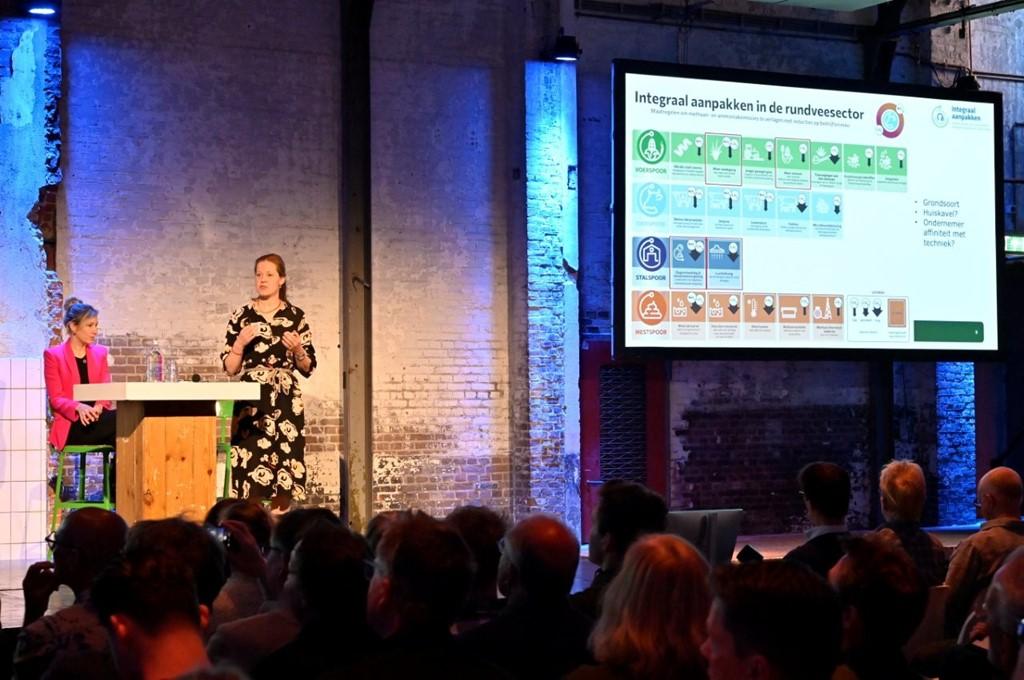
During the sessions, it emerged that opportunities lie in feed, animal, barn and manure. Ration adjustments can have a quick effect, while genetics and steering the microbiome offer longer-term prospects. Good barn management and quick manure handling are also important. This showed that differences between farms are often greater than between systems, underlining the importance of craftsmanship.
An integrated approach focuses on combining measures. This requires careful deliberations, but also offers opportunities to achieve multiple goals at the same time. In the manure track, more and more opportunities are arising to not only reduce emissions, but also exploit them.
For example, through manure fermentation and circular processing concepts, greenhouse gases such as methane and nitrous oxide can be reduced, while at the same time creating space to reduce nitrogen emissions (ammonia). It also offers opportunities for soil and water quality, for example by upgrading manure to compost and fertiliser substitutes.
Scaling up and applying
The biggest challenge lies in practice: scaling up and applying existing knowledge. This calls for clear policy frameworks, cooperation in the chain and appropriate earning models for entrepreneurs.
The Integral Approaches programme formally ended with the symposium, but work is underway on a follow-up. Together with LVVN, Wageningen University & Research and the regional LTOs, new agreements are being made on the further implementation. A follow-up meeting on this is scheduled for 19 May.
'As LLTB, together with ZLTO and LTO Noord, we have actively contributed to this programme,' LLTB chief executive Fons Kersten stressed. 'An integrated approach shows that we can make great strides in reducing greenhouse gases and nitrogen through smart combinations of measures.'
Think of such a measure as green gas from fresh manure. According to Kersten, this not only delivers climate gains, but also environmental and operational benefits. 'It is precisely this integrated approach that makes this a future-proof solution.'
This story appeared in Nieuwe Oogst of Wednesday 13 May