

Nieuws


0 reacties

21x viewed
Imagine a robot carefully picking a ripe strawberry without immediately turning it into jam, a drone flying through a greenhouse to measure the health of cucumber plants and sensors measuring exactly when a tomato is ready to be harvested. From its opening, in June 2026, researchers, students and companies will work together on the future of horticulture, where technology and biology go hand in hand.
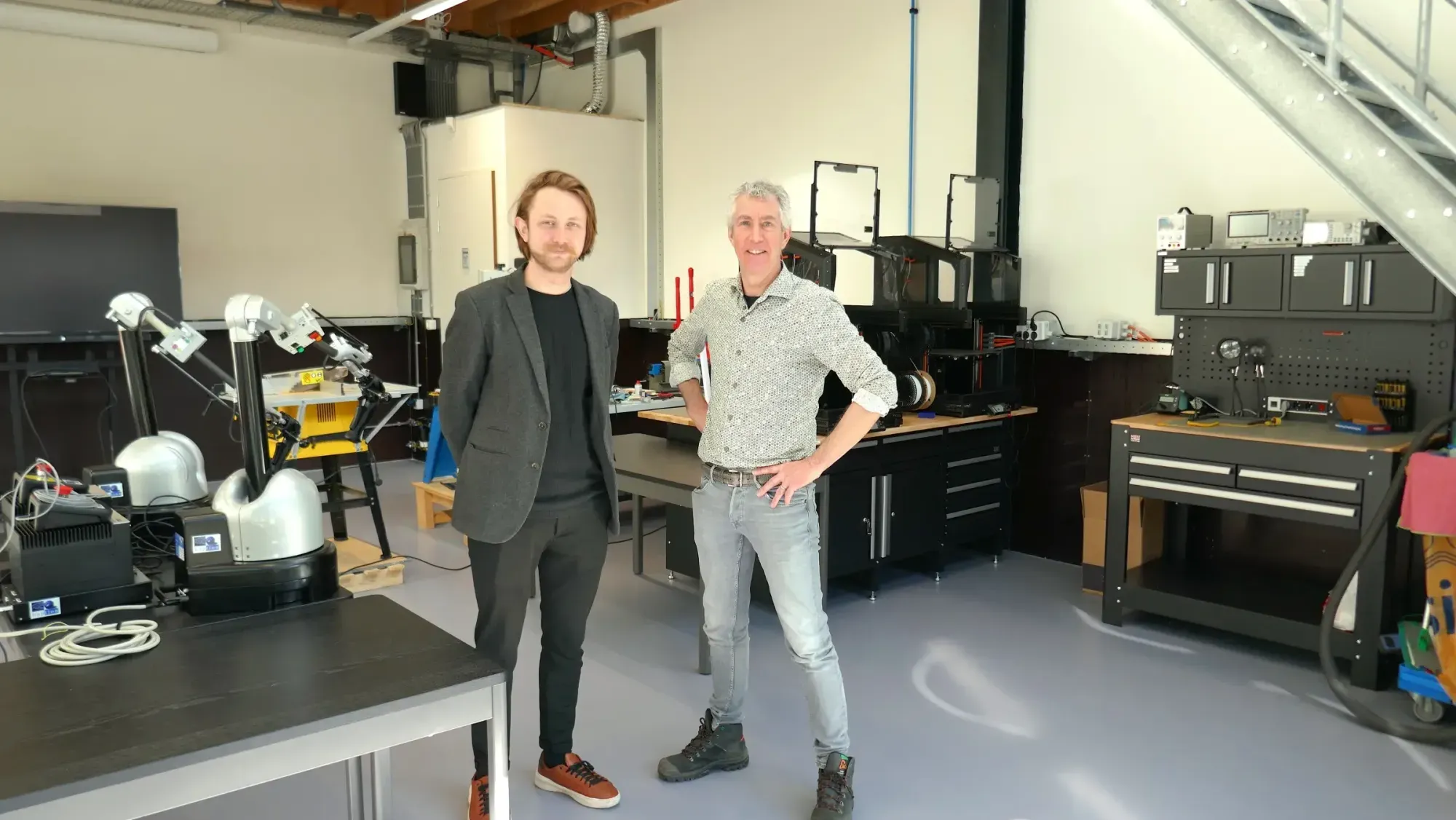
Brightlands High Tech Agro resides in the Brightworks building on Brightlands Campus Greenport Venlo. For those familiar with the campus, the building with the distinctive zigzag roof. "We started preparing the spaces last year," Leonard Lucas, robotics engineer at Maastricht University, tells us. "We had to take out a partition wall and a mezzanine floor so that the lab is high enough for testing drones, robotic arms and sensors." Peter Keunen, building manager at Maastricht University, added: "It was quite a job, but now we have a space that is really suitable for our experiments."
The lab will be equipped with the latest technology: from touch-sensitive collaborative robots (cobots) that work safely with humans to mobile robotic carts that drive through the greenhouse. "We expect many more high-tech devices in 2026," says Leonard.
Robots that harvest, drones that monitor
Peter cites an example of the challenges facing an agritechnical robot: "A robot must be able to visually recognise fruit and pick it carefully, without damaging the plant. This is not easy, because a plant looks different every day. A cucumber or tomato grows, changes colour, doesn't always hang in exactly the same place and can sometimes hang behind a leaf." Researchers are trying to solve such challenges with advanced artificial intelligence.
More than technology
In addition, the scientists are investigating drones that monitor crops. "We want to use drones to collect data on plant health, soil moisture and growing conditions," Leonard says. "That way we can better inform growers about what is happening in their greenhouse."
But it's not just about technology. Plant biology also plays a crucial role. "Adaptations of the plant can help introduce robots into the greenhouse," Peter believes. One example is strawberries of uniform size at the maturity stage. "If all strawberries are the same size and equally ripe, it is much easier for a robot to recognise and pick them," Peter explains. "Breeders can work to breed such a variety that can be harvested more easily by robots. Not at all strange, as the plant is already in the service of humans. Cucumbers are bred so that their fruits always hang at almost the same height, ideal for pickers, whether human or robot."